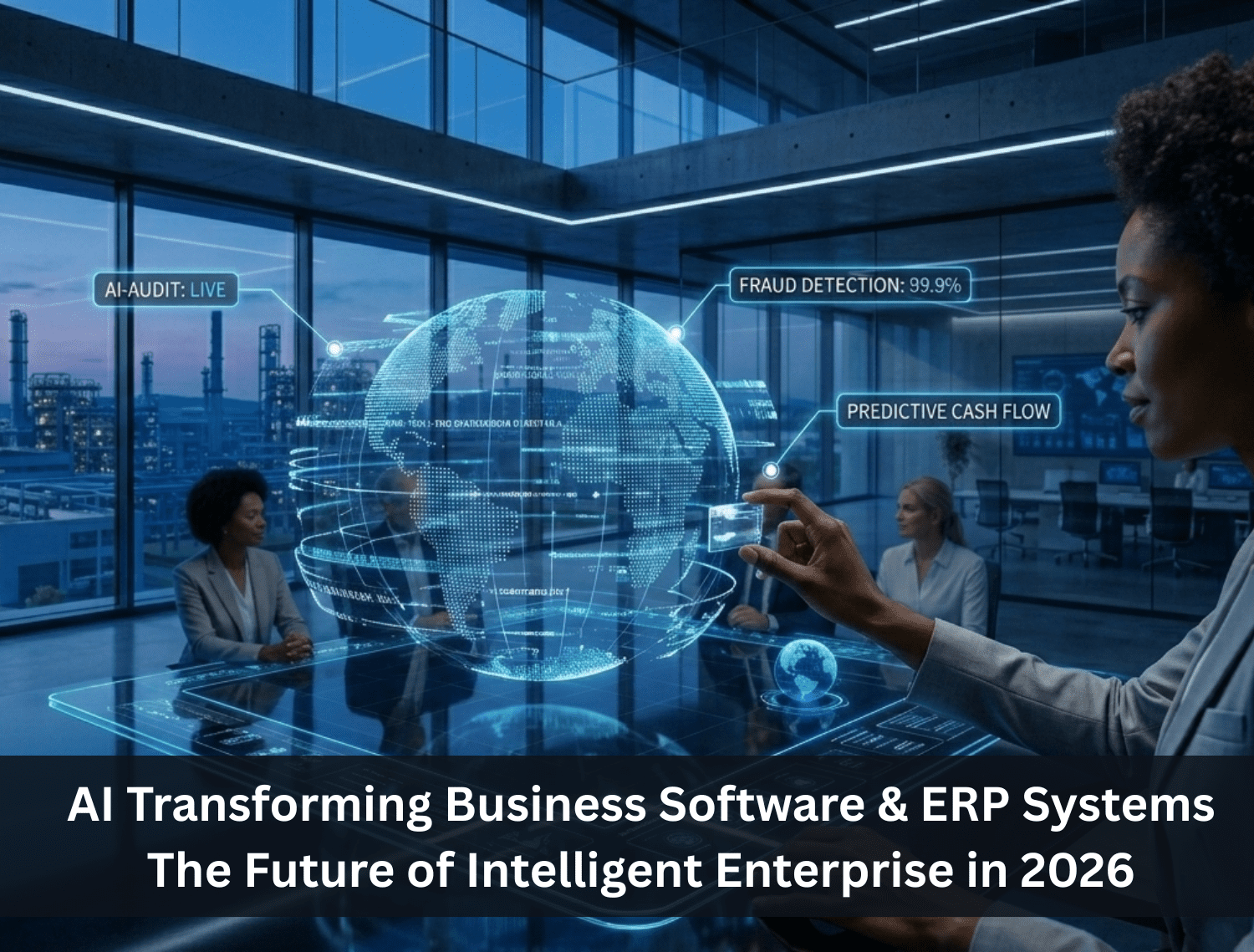
Artificial Intelligence (AI) is no longer just a futuristic concept. It is actively reshaping how businesses operate. In 2026, AI is becoming a key part of business software and Enterprise Resource Planning (ERP) systems. It helps organizations automate tasks, analyze data quickly, and make smarter decisions.
From finance and supply chain management to customer service and human resources, AI is changing how modern businesses manage their operations.
As companies continue to digitize their workflows, integrating AI into ERP systems enables organizations to be more efficient, data-driven, and competitive in a fast-changing market.
What Is AI in ERP Systems?
- It refers to the use of:
- Machine learning
- Predictive analytics
- Natural language processing
These technologies allow ERP platforms to analyze vast amounts of business data and generate insights that help organizations improve decision-making.
Unlike traditional ERP systems that mainly store and organize data, AI-powered ERP systems can:
- Interpret data
- Identify patterns
- Recommend actions to enhance business performance
Key Ways AI Is Transforming ERP Systems
- Intelligent Automation of Business Processes
One of the biggest advantages of Artificial Intelligence in ERP systems is automation. Many repetitive tasks that once required manual effort can now be completed automatically.
Examples include:
- Automated invoice processing
- Smart inventory management
- Automated financial reporting
- Workflow approvals and document processing
- By automating these tasks, businesses can:
- Save time
- Reduce human errors
- Boost overall productivity
- Predictive Analytics for Better Decision Making
AI-powered ERP systems can analyze historical data and generate predictive insights.
- This helps companies:
- Forecast demand
- Optimize inventory levels
- Plan business strategies more effectively
For example:
- Retail companies can predict product demand
- Manufacturers can forecast supply chain disruptions
- Finance teams can identify potential risks and opportunities
- Predictive analytics allows businesses to move from reactive decision-making to proactive strategic planning.
- AI-Powered Chatbots and Virtual Assistants
Modern ERP systems are integrating AI assistants and chatbots that help employees interact with software using natural language.
Employees can simply ask questions like:
“Show me this month’s sales report.”
“What is the inventory level of Product X?”
“Generate a financial summary.”
AI assistants can quickly retrieve information and generate insights.
This makes ERP systems more user-friendly and efficient.
- Smart Supply Chain Management
Supply chain disruptions can significantly impact business performance.
AI helps ERP systems:
Monitor supply chains in real time
Identify potential risks before they arise
With AI, companies can:
- Predict delays in shipments
- Optimize logistics routes
- Monitor supplier performance
- Manage inventory levels efficiently
This results in stronger supply chain resilience and improved operational efficiency.
- Advanced Data Insights and Business Intelligence
- Businesses generate huge amounts of data every day.
- AI helps ERP systems turn this data into actionable insights.
AI-driven analytics tools can:
- Identify hidden patterns in business data
- Generate visual reports and dashboards
- Highlight opportunities for growth
- Detect anomalies and financial risks
- This enables organizations to make faster, data-backed decisions that drive growth and innovation.
Benefits of AI in Business Software
- Organizations that adopt AI-powered ERP systems enjoy several key benefits:
- Increased operational efficiency through automation
- Reduced human errors in financial and operational processes
- Faster data analysis and reporting
- Improved forecasting and planning
- Better customer experience and service delivery
AI is transforming ERP systems from simple data management platforms into intelligent business management solutions.
The Future of AI in ERP Systems
The role of AI in business software will keep growing in the coming years.
New technologies like:
- AI copilots
- Intelligent automation
- Autonomous business processes
- will further enhance ERP capabilities.
Future ERP systems may be able to:
- Automatically optimize business operations
- Detect inefficiencies and suggest solutions
- Provide real-time strategic insights to business leaders
As organizations rely more on data and automation, AI-powered ERP systems will become essential for digital transformation.
Conclusion
AI is fundamentally changing how businesses use software to manage their operations.
By integrating automation, predictive analytics, and intelligent insights into ERP systems, companies can:
- Streamline workflows
- Reduce manual work
- Make better strategic decisions
In 2026 and beyond, organizations that embrace AI-driven ERP solutions will gain a significant competitive advantage by becoming more agile, efficient, and data-driven. For professionals and students looking to build careers in business technology, understanding AI-powered ERP systems and modern enterprise software will be an essential skill for the future.