A few years ago, a “normal” day for an SAP consultant looked something like this: open five browser tabs, dig through SAP Help documentation, scroll an old support ticket thread, ping a senior colleague on Teams, and then start configuring. Half the workday went into finding the answer, not applying it.
That’s the part SAP Joule is quietly rewiring.
If you’re already working on an SAP project, studying for a module, or wondering whether SAP is still worth learning in the age of AI, this is the honest version of what’s changing — and what isn’t.
What Exactly Is SAP Joule?
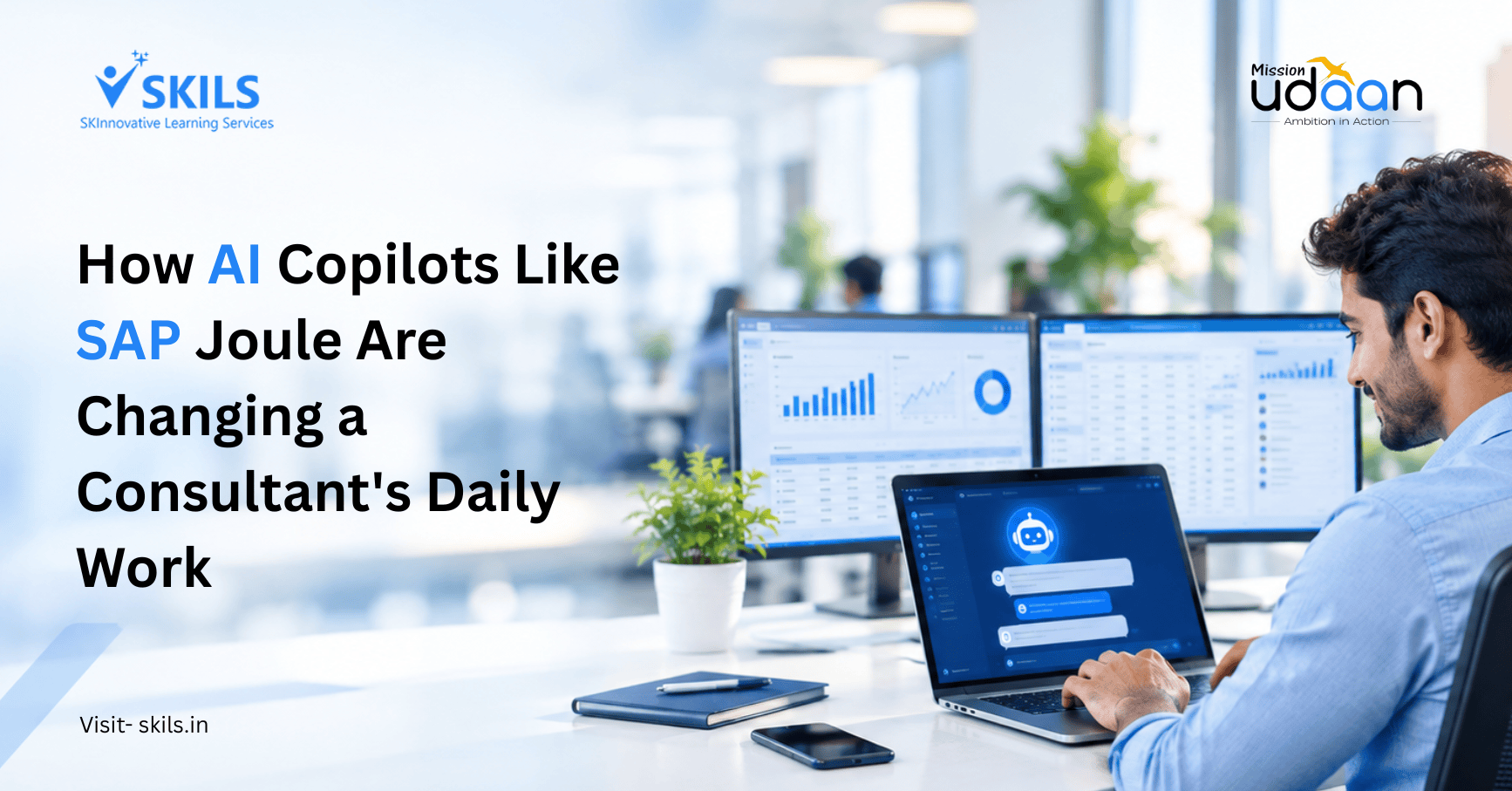
SAP Joule is SAP’s generative AI copilot, built directly into the SAP ecosystem instead of sitting outside it as a separate chatbot. <cite index=”12-1″>SAP offers two versions built for project teams: Joule for Consultants, aimed at speeding up design decisions across SAP cloud transformations, and Joule for Developers, aimed at boosting coding and automation productivity</cite>.
What makes this different from asking a general AI chatbot for help is context. <cite index=”17-1″>Joule for Consultants is trained on an unusually large body of SAP knowledge — roughly 200,000 pages of official documentation, learning material, and community content, comparable to the depth of about 100 SAP certifications combined</cite>. <cite index=”15-1″>By early 2026, it had also grown past simple Q&A into a more agentic tool, working natively inside S/4HANA Cloud, SuccessFactors, Ariba, and SAP BTP</cite>.
In plain terms: it’s not a search bar. It’s a colleague who has actually read the manual, remembers your project’s data, and respects your access permissions.
The Old Daily Grind vs. The Joule-Assisted Day
Here’s what’s actually shifting on the ground, module by module.
1. Research Time Is Collapsing
The old routine — SAP Help, forums, old tickets, “let me ask my mentor” — is being replaced by a direct question inside the system itself. <cite index=”17-1″>A junior consultant on a complex S/4HANA project no longer has to lose days digging through SAP Help, community forums, and learning portals for one configuration answer — they can ask Joule directly and move ahead with a documented, best-practice answer</cite>. For experienced consultants, it’s less about learning from scratch and more about a fast sanity-check against current SAP guidance, which matters on a platform that updates as often as S/4HANA does.
2. Configuration and Testing Get a Co-Pilot
Repetitive setup work — data models, test data enrichment, Fiori screen scaffolding — is increasingly something you review rather than type out line by line. Consultants are already reporting that they can generate data models and design Fiori interfaces faster, and spend that saved time on the parts of the project that actually need human judgment.
3. Reporting and Data Requests Become Conversational
Instead of routing every data request through a report or a support ticket, business users and consultants alike can simply ask. <cite index=”17-1″>If a procurement manager needs to know which vendors have delayed shipments, Joule doesn’t guess or point to a manual — it pulls the live figures straight from the connected supply chain system, respecting that manager’s own data access rights</cite>. That’s one less status meeting on every consultant’s calendar.
4. It Shows Up Everywhere You Already Work
Joule isn’t locked inside SAP GUI. (cite index=”13-1″>SAP has built it, with help from WalkMe, to show up across the everyday tools people already use — ServiceNow, Gmail, LinkedIn, and SAP itself — rather than being one more app to remember to open</cite>. SAP has also been integrating Joule with Microsoft 365 Copilot, so employees can pull SAP and Microsoft data through either assistant without hopping between systems.
So Is SAP Joule Going to Replace SAP Consultants?
Short answer: no — but it is quietly changing what “being good at SAP” actually means.
The old version of expertise was largely about knowing where things are: which transaction code, which table, which config path. Joule is very good at that part now. What it can’t do is decide what a client’s business actually needs, judge whether a “correct” configuration is the right one for that company’s process, or take ownership when something goes wrong in production. <cite index=”16-1″>Put another way, a consultant’s worth is moving away from simply locating information and toward knowing how to steer and judge the AI’s behaviour inside a real business process</cite>.
That’s not a small shift. It means the consultants who get squeezed out are the ones whose entire value was memorized navigation paths and manual data-pulling. The ones who get more valuable are the ones who understand business processes deeply enough to direct an AI copilot, question its output, and take responsibility for the final call.
The Skills That Actually Matter Now
If you’re planning an SAP career in 2026 — or already mid-career and wondering where to invest your learning time — here’s where to focus:
- Core module depth first. You can’t judge whether Joule’s suggestion is right for SAP FICO, MM, SD, CPI, EWM, BTP or HCM if you don’t understand the module yourself. AI amplifies expertise; it doesn’t replace the need for it.
- Prompt literacy for enterprise systems. Asking Joule a vague question gets a vague answer. Knowing how to frame a business scenario clearly is becoming its own skill.
- Process and business judgment. Clients don’t pay for someone who can click through SAP — they pay for someone who understands why a process should work a certain way.
- Comfort with agentic workflows. As Joule moves from answering questions to actually executing multi-step tasks, consultants need to know how to supervise and validate AI-driven actions, not just read AI-generated text.
- Certification, still. A recognized SAP certification remains the fastest way to prove you have the underlying knowledge that AI tools assume you already have.
What This Means If You’re Starting Out
If you’re newer to SAP — a fresher, a career-switcher from a non-IT background, or someone weighing SAP against another tech career — AI copilots are actually good news, not bad news. They lower the barrier to getting started on real work, which means structured, hands-on SAP training matters more than ever, not less. The gap that used to separate a trained consultant from an untrained one — “I know where to look” — is shrinking. The gap that’s replacing it — “I understand the business process and I know how to direct the tools” — is exactly what a good SAP training program is built to teach.
This is where a structured path helps. At SKILS, Pune’s SAP training institute in Baner, learners get hands-on training across S/4HANA, SAP FICO, SD, MM, PP, HCM, ABAP, BASIS,CPI, BTP, EWM,SF and more — with certification guidance and placement support built in, so you’re not just learning the software, you’re learning how to be the person in the room who can make the call an AI copilot can’t.
- Explore SAP S/4HANA training and module-specific courses like SAP FICO, SAP ABAP, and SAP HCM
- Read up on SAP certification vs. training if you’re deciding what to prioritize
- Looking to upskill your team? Check out corporate SAP training at SKILS
FAQs: AI Copilots and the Future of SAP Consulting
1. Will SAP Joule replace SAP consultants? No. Joule automates research, documentation lookup, and routine data tasks, but it can’t take business responsibility, judge client-specific trade-offs, or own project outcomes. Consultants who combine module knowledge with the ability to direct AI tools will stay in demand.
2. Do I still need SAP training if tools like Joule can answer configuration questions? Yes, arguably more than before. Joule assumes you already understand the underlying process well enough to ask the right question and judge the answer. Structured SAP training gives you that foundation — AI just speeds up the parts around it.
3. Which SAP module is best for a career in the AI era? There’s no single “best” module — it depends on your background. Finance-minded learners often do well with SAP FICO, technical learners gravitate toward ABAP or BASIS, and those interested in HR go for SAP HCM/SuccessFactors. What matters more now is pairing your module with comfort using AI copilots like Joule inside real projects.
4. How is SAP Joule different from a general AI chatbot like ChatGPT? Joule is embedded directly inside SAP applications and grounds its answers in live, permission-based SAP data and SAP’s own documentation, rather than general internet knowledge. It’s built to act inside your actual system, not just describe it.
5. Is SAP training still worth it in 2026 with AI copilots around? Yes. Demand for SAP professionals hasn’t dropped — companies still need people who understand ERP processes end to end. What’s changed is that basic navigation skills matter less, while process knowledge, certification, and the ability to work alongside AI tools matter more.
6. How can I become an SAP consultant who works well with AI copilots like Joule? Start with solid fundamentals in a core module (FICO, MM, SD, ABAP, etc.) through a structured training and certification path, then build hands-on project exposure where you practice using AI copilots for research and configuration — while still owning the business decisions yourself. A training institute with placement support, like SKILS in Pune, can help you get both the certification and the real-project exposure at once.
Read more about SAP Joule- https://help.sap.com/docs/joule/serviceguide/sap-consulting-capability-for-joule
Looking to build an SAP career that’s ready for the AI era? Explore SAP training courses at SKILS, Pune’s leading SAP training institute — with certification and placement support included.