If you’ve spent any time around SAP integration consultants this year, you’ve probably heard the same thing again and again: SAP CPI isn’t the tool it was two years ago. What used to be a solid, in-demand skill for connecting SAP and non-SAP systems has turned into one of the fastest-moving, most talked-about specializations inside the SAP ecosystem — and 2026 is the year that shift has become impossible to ignore.
For working professionals, freshers, and anyone weighing a SAP training institute in Pune or elsewhere, that’s genuinely good news. Integration skills are becoming the connective tissue of every SAP S/4HANA, SuccessFactors, and BTP rollout, and companies are actively hunting for people who understand it. Let’s break down exactly what’s changing in SAP CPI this year, and why now is a smart time to build (or upgrade) your career around it.
What Is SAP CPI, Quickly?
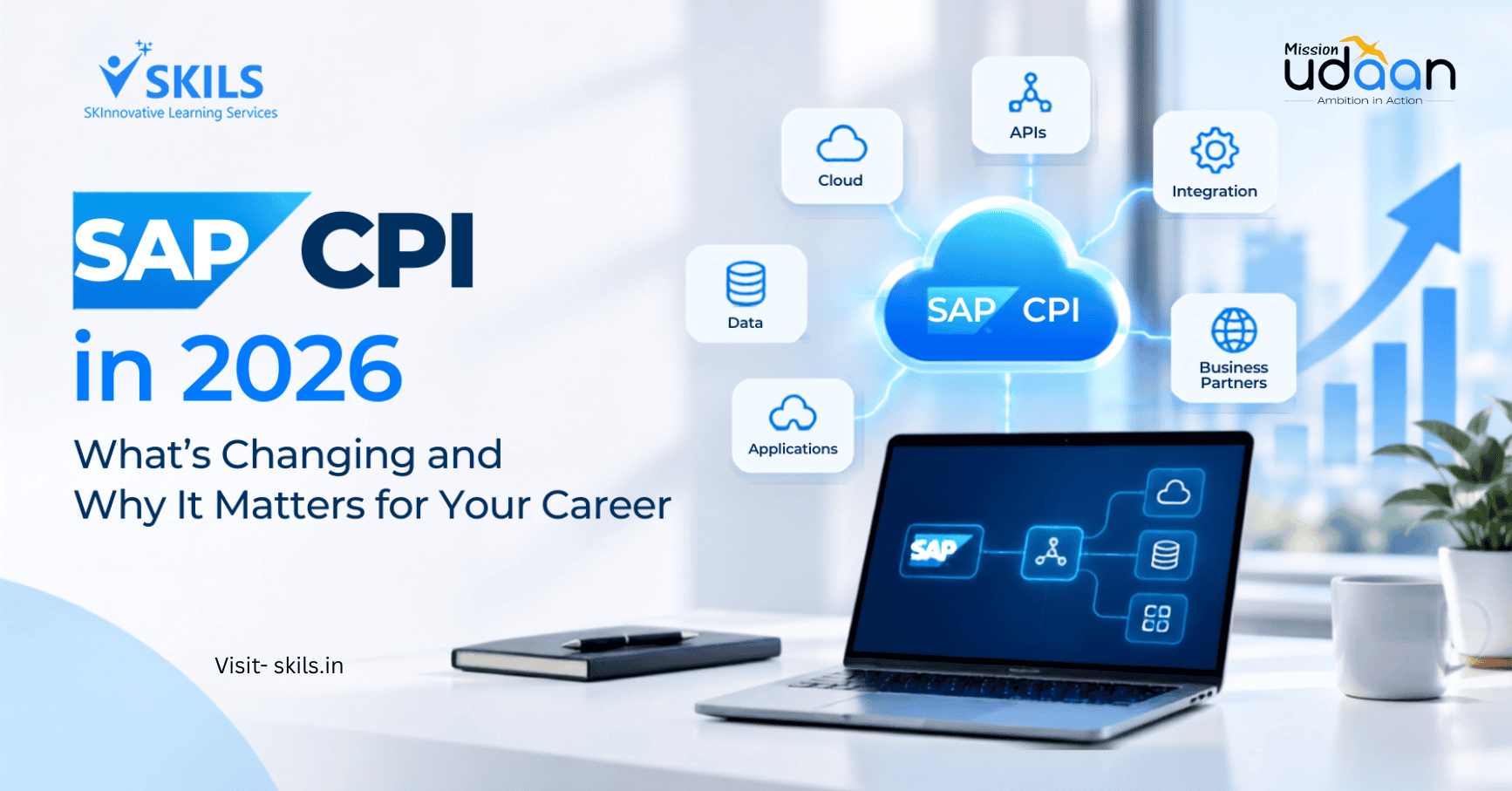
SAP CPI — Cloud Platform Integration, now officially part of SAP Integration Suite on SAP Business Technology Platform (BTP) — is SAP’s cloud-native tool for connecting systems. Instead of writing custom point-to-point code between SAP and third-party applications, integration consultants build “iFlows” (integration flows) that move, transform, and route data between systems like S/4HANA, SuccessFactors, Ariba, Salesforce, and countless others.
If you’ve come across SAP FICO training, SAP MM training, or SAP SuccessFactors training and wondered how all these modules actually “talk” to each other and to the outside world — CPI is very often the answer. It sits at the center of nearly every modern SAP landscape, which is exactly why it’s become such a valuable skill to learn.
Why SAP CPI Is Having a Moment in 2026
A few forces are converging at once, and together they’re reshaping what it means to be an integration consultant.
1. AI Is Now Built Into the Integration Workflow
The biggest shift in 2026 is how much artificial intelligence has been folded directly into Integration Suite. SAP’s AI copilot, Joule, can now help generate integration flows from plain-language descriptions, assist with message transformation, and support B2B scenario design — work that used to require manually dragging and configuring every adapter and mapping step. SAP has also demonstrated migration-focused AI agents capable of converting legacy SAP PI/PO content into modern Groovy scripts, which matters enormously for the wave of companies still moving off older middleware.
Other AI-assisted capabilities rolling out with the enhanced edition include script optimization (AI reviewing and refactoring Groovy scripts used inside Cloud Integration), anomaly detection in API traffic, and predictive monitoring that flags unusual message behavior before it becomes a production issue.
The practical takeaway: manual, repetitive iFlow-building is being automated, and the value is shifting toward consultants who can design integration architecture, validate AI-generated flows, and handle the judgment calls the AI can’t make on its own.
2. The “Enhanced Edition” and the Push Toward Agentic Integration
SAP has repositioned Integration Suite’s enhanced edition as more than an incremental upgrade — it now bundles application and B2B integration, API management, edge integration, advanced event mesh, and SAP Document AI as a single package built for what SAP calls the “autonomous enterprise.” A big part of this is the new MCP Gateway inside API Management, which lets Joule AI agents securely reach data in non-SAP systems through Model Context Protocol servers — effectively giving AI agents a standardized way to plug into whatever a company already has running.
On top of that, SAP has confirmed plans to bring the workflow-automation platform n8n into Joule Studio as a managed environment, giving BTP developers a low-code way to orchestrate AI agents, human approvals, and cross-system workflows without leaving the SAP-governed environment.
For consultants, this means the boundaries between “integration,” “automation,” and “AI agent orchestration” are blurring — and the people who understand more than one of these areas will have a real edge.
3. Certification Is Catching Up
With CPI capabilities moving this fast, SAP’s certification track is being updated too. The community has been actively discussing the rollout of the next C_CPI exam and its transition to a refreshed 2026 exam format, reflecting the expanded scope of Integration Suite rather than the older, narrower Cloud Integration syllabus. If you’re planning a SAP certification path in integration, it’s worth checking the latest exam guide before you start preparing, since older material may not fully match what’s being tested now.
4. Integration Skills Are Now a BTP Career Multiplier
SAP CPI no longer sits in a silo. It’s increasingly bundled with broader BTP skill sets — CAP model development, generative AI extensions, and Clean Core architecture — because companies want consultants who can build integrations and extend SAP intelligently rather than just connect systems. Reports from SAP’s own Sapphire 2026 event pointed to AI-related SAP roles growing sharply over the past year, with AI-certified professionals commanding a noticeable pay premium over non-AI-certified peers in similar roles.
Why This Matters for Your Career Right Now
Here’s the part that should actually change how you think about your next move:
- Demand is shifting toward integration specialists, not away from them. AI is removing the grunt work, not the role. Every company running S/4HANA, SuccessFactors, or a hybrid landscape still needs someone who understands how the pieces connect — they just need that person to work faster and think more strategically.
- Early movers get the advantage. Because the AI-driven capabilities are new, there’s a real window right now for professionals who learn Joule-assisted integration development, MCP Gateway concepts, and the updated CPI certification syllabus before the market catches up.
- It’s a strong path for career switchers, not just IT veterans. Because more of the manual coding is AI-assisted, structured SAP training for beginners in CPI is more approachable than it used to be — which is great news whether you’re coming from a SAP training after mechanical engineering background, an MBA, or a non-IT role and looking to start a career in SAP without experience.
- It pairs well with other high-value modules. Consultants who combine CPI with SAP S/4HANA training, SAP SuccessFactors training, or SAP ABAP training are especially attractive to employers building modern, connected landscapes — and typically negotiate stronger packages than single-module specialists.
How to Build a Career in SAP CPI From Here
If you’re convinced integration is worth investing in, here’s a realistic path:
- Start with the fundamentals. Understand iFlow design, adapters, message mapping, and the basics of API Management before jumping into AI-assisted tooling — you need to be able to evaluate what Joule generates, not just accept it.
- Get hands-on with real scenarios. Look for a SAP training institute that includes live projects and real-time integration scenarios rather than slide-only theory, since this is a tool best learned by building actual iFlows.
- Layer in certification. Once you’ve built practical skills, target the current C_CPI certification track using the latest exam guide, not outdated material.
- Pick a complementary module. Decide which SAP module is best for your career by pairing CPI with a functional area you’re drawn to — Finance (FICO), HR (SuccessFactors), or technical development (ABAP) are all strong combinations.
- Look for placement support. A SAP training institute with placement assistance, real-time project exposure, and corporate training partnerships will get you interview-ready faster than self-study alone.
Where SKILS Fits In
At SKILS, our SAP training programs in Baner, Pune are built around exactly this kind of hands-on, industry-aligned learning — whether you’re exploring integration, S/4HANA, FICO, ABAP, SuccessFactors, or another module. Our courses combine practical, real-time projects with certification guidance and placement support, so you’re not just learning SAP concepts — you’re learning how to actually work as an SAP consultant.
Whether you’re looking for SAP training in Pune, an online SAP course with flexible batches, or corporate SAP training for your team, our trainers help you map the right learning path based on where the SAP ecosystem — and the job market — is actually heading in 2026 and beyond.
FAQs: SAP CPI and SAP Career Training in 2026
Is SAP training worth it in 2026?
Yes — especially in fast-moving areas like integration, AI-extended BTP development, and modules tied to S/4HANA transformation projects. Demand for consultants who can bridge classic SAP modules with newer cloud and AI capabilities continues to grow.
Which SAP module is best for a career right now?
It depends on your background, but integration (CPI/Integration Suite), S/4HANA, FICO, and SuccessFactors are consistently among the highest-demand, highest-paying specializations, particularly when combined with certification.
How long does SAP CPI training take?
This varies by institute and format, but most structured, hands-on SAP training courses covering CPI fundamentals through practical iFlow-building can be completed in a matter of weeks with a live-project component — ask any institute you’re considering for their exact course duration and syllabus.
Can I switch to an SAP integration career without an IT background?
Yes. Many professionals move into SAP integration roles from mechanical engineering, commerce, or MBA backgrounds through structured, beginner-friendly training and real-time project practice — it’s less about your degree and more about your willingness to learn the platform hands-on.
Ready to future-proof your SAP career with hands-on Integration Suite and CPI training? Talk to SKILS about our SAP training courses in Pune, including placement assistance and corporate training options.