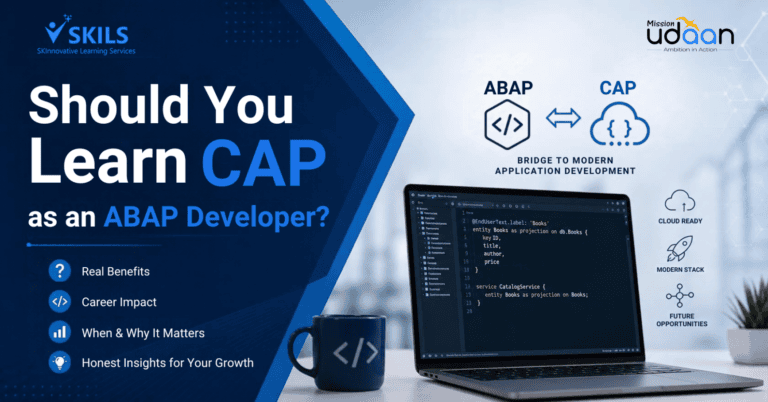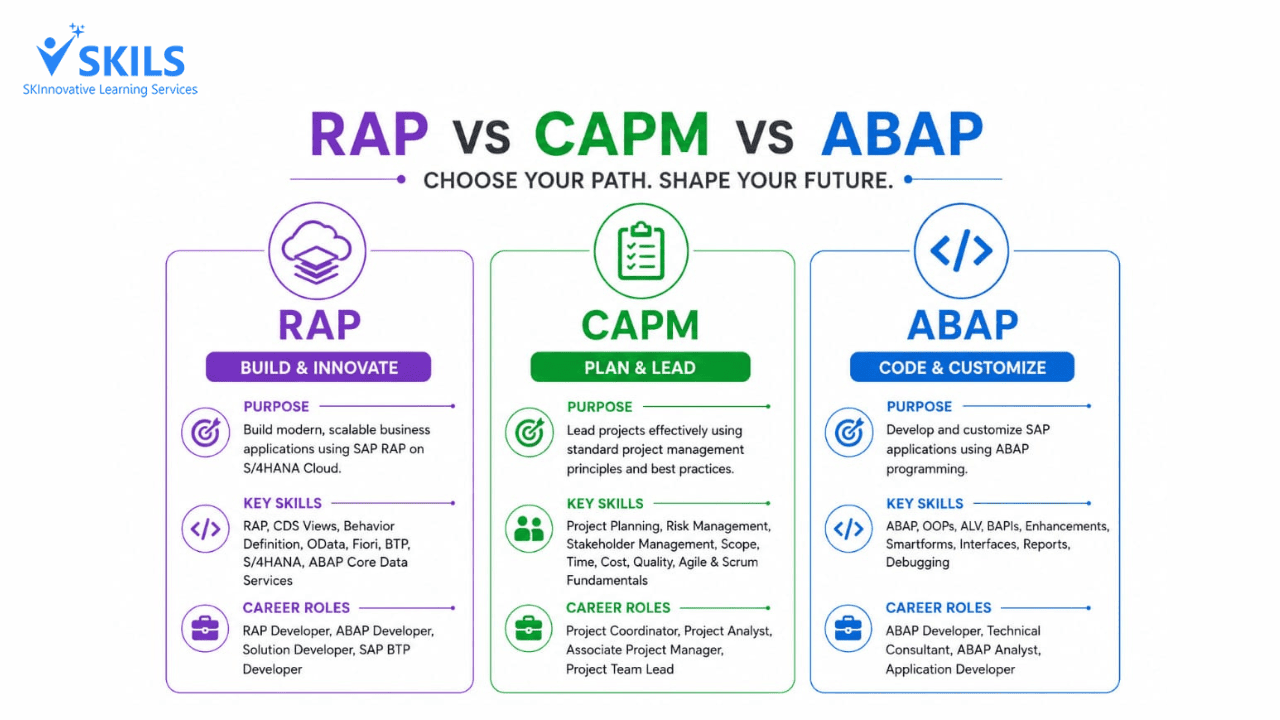
let’s settle the RAP vs CAPM vs ABAP debate once and for all
What is ABAP? The Backbone of SAP
ABAP (Advanced Business Application Programming) is SAP’s original, purpose-built programming language. It has powered SAP systems since the 1980s and still runs the core business logic inside thousands of SAP ECC and SAP S/4HANA landscapes worldwide.
Think of ABAP as the language that quietly keeps the lights on in finance, logistics, HR, and manufacturing systems across the globe. It’s stable, mature, deeply integrated with the SAP database layer, and — despite predictions of its retirement — still one of the most in-demand skills in the SAP job market.
Why ABAP still matters:
- Runs the core business logic in almost every SAP S/4HANA and ECC system
- Backward compatible, so 20-year-old custom code still works
- Massive existing job market — most SAP implementations still rely on classic ABAP developers
- A strong entry point into the broader SAP technical ecosystem
If you’re just starting your SAP journey, a solid SAP ABAP training foundation is still one of the smartest first steps, because both CAPM and RAP are built on top of ABAP concepts like CDS views and OData.
What is CAPM? SAP’s Cloud-Native Programming Model
CAPM (SAP Cloud Application Programming Model), often just called CAP, is SAP’s framework for building brand-new, cloud-native applications on SAP Business Technology Platform (BTP). Unlike ABAP, CAPM doesn’t use ABAP as its core language — it’s built around Node.js and Java, combined with Core Data Services (CDS) for the data modelling layer.
CAPM is designed for developers who think in terms of microservices, APIs, and modern web architecture rather than traditional SAP transactions.
Where CAPM shines:
- Building side-by-side extensions that sit outside the SAP core system
- Cloud-first, multi-cloud, and open-source-friendly projects
- Teams with Java or JavaScript backgrounds who want to build on SAP BTP
- Rapid, agile development of new business applications
CAPM appeals to developers who want SAP exposure without committing fully to the ABAP language — a great option if your background is in modern web or backend development.
What is RAP? The Modern Face of ABAP
RAP (ABAP RESTful Application Programming Model) is where things get interesting — and where most of the current hiring demand is heading. RAP lets ABAP developers build modern, RESTful, Fiori-ready applications using ABAP itself, following a clean, structured approach based on:
- CDS views for the data model
- Behavior definitions for business logic
- Service bindings to expose everything as OData services
In simple terms: RAP takes everything good about ABAP’s stability and pairs it with the “clean core” architecture SAP is pushing every customer toward on S/4HANA and S/4HANA Cloud. SAP now officially recommends RAP as the go-to model for new ABAP-based development, whether on-premise or in the cloud.
Why RAP is the model to watch:
- SAP’s official recommendation for new S/4HANA extensions
- Lets experienced ABAP developers upgrade their skillset without learning a new language
- Fully aligned with clean core and upgrade-stable custom development
- Increasingly asked for in SAP job descriptions and interviews for 2026 and beyond
RAP vs CAPM vs ABAP: Quick Comparison
| Aspect | ABAP (Classic) | CAPM | RAP |
|---|---|---|---|
| Core language | ABAP | Node.js / Java | ABAP |
| Best for | Existing SAP core logic | New cloud-native apps outside SAP core | New/extended apps inside SAP S/4HANA |
| Database | SAP HANA / any DB | HANA, SQLite (dev), PostgreSQL | SAP HANA |
| Deployment | On-premise SAP systems | SAP BTP (cloud) | On-premise, BTP, S/4HANA Cloud |
| Learning curve for ABAP developers | Native | Requires new language skills | Low — builds on existing ABAP knowledge |
| SAP’s current recommendation | Maintenance of legacy systems | New cloud-native, side-by-side extensions | New core extensions and Fiori apps |
So Which One Should You Learn First?
Here’s the honest, experience-based answer: it depends on where you’re starting from and where you want to end up.
- If you’re new to SAP → Start with ABAP fundamentals. Every SAP technical career path — whether you move toward RAP, CAPM, Fiori, or BTP — is easier to understand once you know how ABAP and CDS views work.
- If you’re an experienced ABAP consultant → Upskill into RAP. It’s SAP’s direction for the future, it’s what recruiters are increasingly screening for, and it protects your existing ABAP expertise instead of replacing it.
- If you come from a Java/JavaScript/web development background → CAPM lets you bring your existing skills into the SAP ecosystem without learning ABAP from scratch.
For most learners we meet at SKILS, the smartest career move is building strong ABAP fundamentals first, then layering RAP on top — since that combination keeps you relevant across both traditional SAP landscapes and the new clean-core, S/4HANA-driven world.
Build Your SAP Career the Right Way — with SKILS
At SKILS (SKInnovative Learning Services Pvt. Ltd.), we’ve spent years helping students and working professionals in Pune and across India build real, job-ready SAP skills — not just theoretical knowledge. Our SAP S/4HANA ABAP training program is designed to take you from the fundamentals all the way to real-time project scenarios, with the same clean-core and RAP-aligned concepts that today’s employers are looking for.
Along with SAP ABAP, SKILS also offers industry-relevant training in SAP FICO, SD, MM, PP, HCM, BASIS, EWM, SAP CPI, SAP RAR, and Business Analyst Training — with flexible online, classroom, and self-paced learning modes to suit your schedule.
Whether you’re a fresher trying to break into SAP or a consultant looking to future-proof your skills with RAP, SKILS’ experienced trainers and placement-focused approach can help you get there.
Explore the SAP ABAP Training program at SKILS, or check out our full range of SAP Training courses to find the right path for your career.
Have questions about which SAP module or programming model fits your career goals? Reach out to the SKILS team at training@skils.in or explore our Training Calendar to find the next batch near you.
What is the main difference between RAP, CAPM, and ABAP?
ABAP is SAP’s traditional programming language that runs core business logic inside SAP systems. CAPM (Cloud Application Programming Model) is a cloud-native framework built on Node.js/Java for creating new apps on SAP BTP. RAP (RESTful ABAP Programming Model) is the modern way to build REST-based, Fiori-ready apps using ABAP itself — combining ABAP’s stability with cloud-ready architecture.
No. RAP is built on top of ABAP, not a replacement for it. It uses ABAP as its core language but adds a modern, structured approach (CDS views, behavior definitions, service bindings). Classic ABAP skills remain the foundation for learning RAP.
If you’re new to SAP, start with ABAP fundamentals — they form the base for both RAP and CAPM. Experienced ABAP developers should upskill into RAP, since SAP now recommends it for new S/4HANA development. If you come from a Java/JavaScript background, CAPM is the easier entry point.
Both have strong demand, but they suit different profiles. RAP is in higher demand among ABAP consultants working on SAP S/4HANA and clean-core projects. CAPM is better suited to developers building cloud-native, side-by-side extensions on SAP BTP. Many SAP professionals eventually learn both.
SKILS (SKInnovative Learning Services Pvt. Ltd.) offers structured SAP ABAP training covering both classic ABAP and RAP concepts, along with SAP FICO, SD, MM, PP, HCM, BASIS, EWM, CPI, and RAR training — with flexible online and classroom options.